
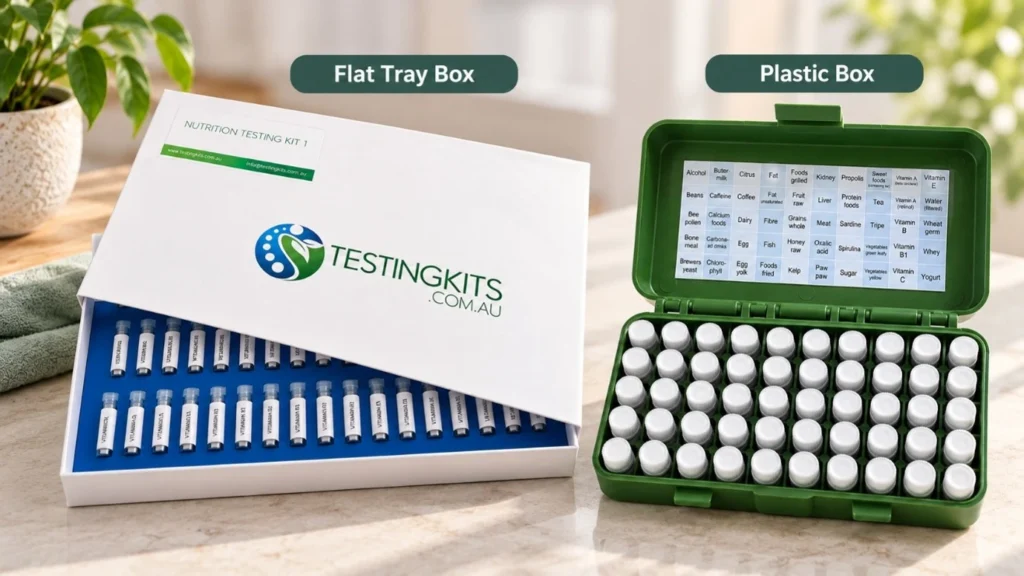
Our Test Kits are available in two box styles: the Plastic Box, where the vials are stored vertically, and the Flat Tray Box, where the vials are stored horizontally.
The Test Vials themselves are exactly the same in both options. The difference is how they are stored, viewed and accessed during testing. Which style is best depends largely on your testing method and how you prefer to work.
In the Flat Tray Box, all 50 vials are stored horizontally, with the vial labels clearly visible when the box is opened. This makes it easy to scan the entire Test Kit, locate individual vials and return them to the correct position after use.
Bioresonance practitioners almost always choose the Flat Tray Box. During bioresonance testing, practitioners may work systematically through a number of vials, selecting individual vials for testing with their equipment. Having every vial clearly visible and accessible makes this process quicker and easier, particularly when moving through a Test Kit vial by vial or working with several selected vials during a session.
The flat layout also makes it immediately obvious which vials have been removed and where they belong, helping to keep the Test Kit organised throughout testing.
In the Plastic Box, all 50 Test Vials are stored vertically in individual compartments. A contents guide inside the lid identifies the position of each vial.
Plastic Boxes are compact, durable and take up considerably less storage space than Flat Tray Boxes. This can be particularly useful for practitioners who have a large collection of Test Kits or limited storage space in their clinic.
Their smaller size and sturdy construction also make them an excellent option for practitioners who travel between clinics, work from different locations or regularly take their Test Kits with them.
Some practitioners deliberately choose the Plastic Box for another reason. Because the vial names are not visible while the vials are sitting upright in the box, they can test a vial without immediately knowing what it contains.
For practitioners using muscle testing, this can help keep the testing process more objective by reducing the potential influence of conscious expectations or assumptions. The vial can simply be identified after the testing response has been obtained.
Which Box Should You Choose?
For bioresonance practitioners, the Flat Tray Box is generally the preferred option because the visible, horizontal arrangement works particularly well when selecting and working through multiple vials during testing.
For kinesiologists, NAET practitioners and others using muscle testing, either style can work well. If you want all vial names immediately visible and easy to select, the Flat Tray Box may suit you better. If you prefer a compact, durable box that takes up less space, is easy to travel with, and gives you the option of testing without seeing the vial name first, the Plastic Box may be the better choice.
Whichever box style you choose, the Test Vials and Test Kit contents are exactly the same.