
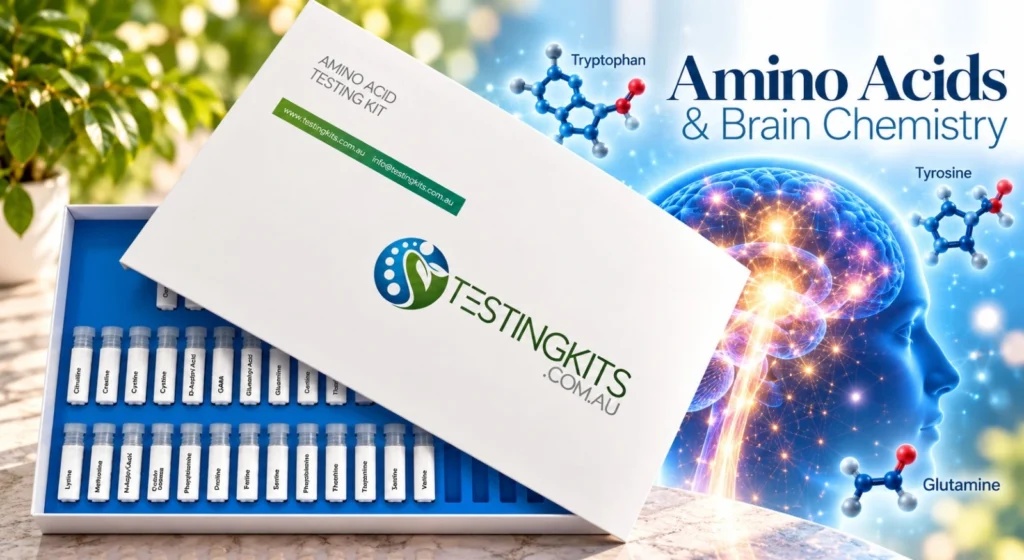
Amino acids are usually introduced as the building blocks of protein, but their role in the body goes far beyond structural repair. They are also the raw materials used to produce many of the body’s most important signalling molecules, including neurotransmitters involved in mood, sleep, motivation, focus and the stress response.
Without amino acids, the brain cannot produce many of its chemical messengers.
Why Amino Acids Matter for Brain Chemistry
Several important neurotransmitters are produced from specific amino acids.
Tryptophan is converted into serotonin, which is involved in mood, appetite and sleep. Serotonin can subsequently be converted into melatonin, which plays an important role in regulating the sleep-wake cycle.
Tyrosine is a precursor for dopamine, noradrenaline and adrenaline. These signalling molecules are involved in motivation, attention, alertness and the body’s response to stress.
Glutamine plays an important role in the glutamate/GABA-glutamine cycle in the brain. Within this cycle, glutamine supplied by astrocytes is used by neurons as a precursor for the synthesis of glutamate and GABA, the brain’s principal excitatory and inhibitory neurotransmitters.
Because these pathways depend on amino acids, the availability and metabolism of amino acids can influence neurotransmitter synthesis.
A Detail That Is Often Overlooked
Adequate protein intake does not necessarily mean that every amino acid reaches the brain in equal amounts.
Several amino acids use shared transport systems to cross the blood-brain barrier and therefore compete with one another for transport into the brain.
Tryptophan, for example, competes with other large neutral amino acids including leucine, isoleucine, valine, tyrosine and phenylalanine. The relative concentrations of these amino acids in the bloodstream can therefore influence how much tryptophan reaches the brain and is available for serotonin synthesis.
This means that brain amino acid availability is influenced not simply by the amount of protein consumed, but also by the relative balance of amino acids in circulation.
Digestion and Absorption Matter Too
Before amino acids from food can participate in these pathways, dietary proteins first need to be broken down during digestion.
Proteins are progressively broken into smaller peptides and amino acids before being absorbed through the intestinal lining. Digestive function and nutrient absorption therefore form an important part of the pathway between dietary protein and the eventual availability of amino acids to the body.
Amino acid metabolism also relies on other nutrients and enzyme systems, adding another layer to the relationship between nutrition and neurotransmitter production.
Amino Acids in Practitioner Testing
For practitioners, amino acids can be a useful area to consider alongside other factors relating to nutrition, digestion, metabolism and neurotransmitter pathways.
For practitioners wanting to assess individual amino acids in greater detail, we also have a dedicated Amino Acid Test Kit, available in a Plastic Box and Flat Tray Box.
References
Fernstrom, J.D. (2013). Large neutral amino acids: Dietary effects on brain neurochemistry and function. Amino Acids, 45(3), 419–430. https://doi.org/10.1007/s00726-012-1330-y
Daniel, P.M., Moorhouse, S.R. & Pratt, O.E. (1976). Amino acid precursors of monoamine neurotransmitters and some factors influencing their supply to the brain. Psychological Medicine, 6(2), 277–286. https://doi.org/10.1017/S0033291700013830
Andersen, J.V. (2025). The glutamate/GABA-glutamine cycle: Insights, updates, and advances. Journal of Neurochemistry, 169(3), e70029. https://doi.org/10.1111/jnc.70029
Ten Have, G.A.M., Engelen, M.P.K.J., Luiking, Y.C. & Deutz, N.E.P. (2007). Absorption kinetics of amino acids, peptides, and intact proteins. International Journal of Sport Nutrition and Exercise Metabolism, 17(Suppl.), S23–S36. https://doi.org/10.1123/ijsnem.17.s1.s23